


A complex systemic disease that is accompanied by skin lesions is psoriasis.In a healthy body, cells live for 30 to 40 days and then renew themselves.With the development of psoriasis, the life of skin cells is 4-5 days.When they die, peeling, plaques and dryness occur.Treatment of psoriasis in the initial phase is always simpler, so it is important not to let the disease progress.Treatment methods for the progressive phase differ significantly.In the article you will read about the treatment of only the initial stage of psoriasis.
Causes of the disease
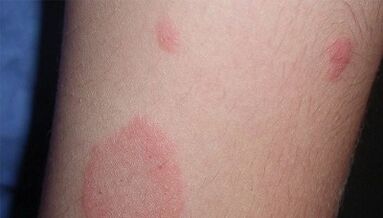
With psoriasis, the functioning of several systems is disrupted at once: endocrine, immune and nervous.Doctors have not fully discovered the causes of this disease or invented a cure for psoriasis.
Experts put forward the following hypotheses about the development of the disease:
- viral.The causative agent of psoriasis may be retroviruses that are inherited.Many patients had changes in the peripheral lymph nodes, which may indicate the viral nature of the disease.
- Immune.With weakened immunity and disruption of protective mechanisms at the cellular level, favorable conditions arise for the progression of psoriasis.Among the causes of the disease is also autoimmune aggression, a process in which lymphocytes begin to attack the body's own healthy cells.
- Infectious.Many researchers have searched for the causative agents of psoriasis.Epidermophytons, spirochetes, and streptococci were suspected, but all assumptions remained incorrect.However, scientists have found that infectious diseases: ARVI, influenza, sore throat are the triggering mechanism for the development of psoriasis.In 90% of cases, this disease is accompanied by tonsillitis.
- Genetic.Psoriasis is transmitted to the child from the parents.60% of patients have family members who suffer from this skin disease.If a mother or father is diagnosed with psoriasis, the risk of a child suffering from this disease increases by 25%, if both parents are sick - by 60%.
- Metabolic.Metabolic disorders (lipids, carbohydrates, vitamins, minerals) can cause psoriasis.Patients often experience disorders in the functioning of the thyroid gland and other glands of the endocrine system.
Main signs and symptoms.
This local disease is not contagious.Skin, nails and hair are damaged.Small rashes appear on the epidermis, in which, over time, papules - bright red or pink areas protruding from the skin - form.From above they are covered with silvery scales (plates).
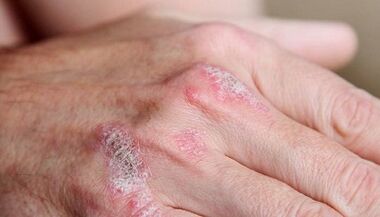
The papules may itch a little or not bother at all, the peeling is not noticeable.At first, the size of the affected skin areas is 1 to 2 millimeters, over time their size is estimated at 10 centimeters or more.
Initial stage of psoriasis: what areas of the body can the disease affect?The main symptoms of the disease in different locations:
- In the head.The scalp is covered in red, scaly patches with a large number of scales that resemble dandruff.Hair does not participate in the pathological process.Patients experience itching.Skin lesions may extend to the neck and behind the ears.
- In the face.At the initial stage, psoriatic plaques form on the skin around the eyes, on the eyelids, in the area of the nasolabial folds and on the eyebrows.Sometimes, psoriasis affects the mucous membranes of the mouth, cheeks, lips, tongue and, a little more often, the area around the lips.
- In my arms.Single red papules appear on the palms and between the fingers.The back of the hand is affected much less frequently.If spots form on the fingertips, sensitivity is lost over time.Psoriasis can spread to the nails.
- On the elbows.At the initial stage, unique elements of psoriasis appear, covered with silvery scales.They then grow into a continuous area of affected skin, from which the scales and thin film are easily removed.After this action, the affected area turns a pinkish red color and drops of blood appear.
- Standing.The skin of the foot and the back of the leg suffers.The symptoms are similar to those that occur with elbow psoriasis: in the initial stage, small lesions appear that grow in large areas and a blood spray symptom is observed.
How and with what to treat psoriasis in the initial stage.

Cure psoriasis forever: how realistic is it?Unfortunately, the answer so far is disappointing: this autoimmune disease can be corrected, but it is impossible to get rid of it completely.
Treatment of psoriasis at the initial stage gives excellent results and allows you to get rid of the visible manifestations of the pathology.Traditional medicine uses ointments, creams, solutions, therapeutic ultraviolet irradiation and systemic drug treatment.There are also grandmother's remedies, but they do not give a stable result.
Hypoallergenic diet
Patients with different types of psoriasis need to learn the basics of an alkaline diet.Patients need to eat foods that alkalize the internal environment.Their proportion should be 65-75%, the proportion of acidic foods should be 25-35%.
General recommendations:
- One third of the diet consists of unprocessed fruits and vegetables.Include beets, cabbage, carrots, herbs, cucumbers, onions, garlic and celery in your menu.
- Another third of the daily menu for psoriasis is complex carbohydrates and natural sweets in limited quantities.Eat porridge (barley, buckwheat), dried fruits (raisins, dried apricots, dates).
- The last part of the diet is animal and vegetable proteins.Eat lean meats, fish, peas, beans, seeds, eggs and nuts.Polyunsaturated fatty acids should also be included in the menu.
- Drink at least 7 to 10 glasses of clean water a day.Alcohol is prohibited.
- For effective treatment, avoid citrus fruits, fatty dairy products and meat, chocolate and red foods.Use honey to a minimum.
- It is important to exclude sweet, spicy, smoked and sour foods from the diet, as they have a negative effect on the skin.The amount of salt should be reduced to a minimum.
Drug therapy
Treatment of psoriasis in the initial stage is successful with the prescription of medications.There are several groups of them.
Local preparations: creams and ointments.The medicines consist of water, emulsifier and oil.They are sufficient to treat the initial stage of psoriasis.
Ointments are hormonal and non-hormonal.The second group is safer, but not as effective.
Tablets.Treatment of psoriasis with medications is most often used to combat the advanced stage.
Systemic therapy.Its nature (dose, duration of therapy) is determined solely by a doctor for the treatment of advanced forms of pathology.
Complex uses:
- vitamins;
- fatty acids;
- hepatoprotectors;
- immunomodulators;
- antiallergic agents;
- Medications to eliminate toxins from the intestines.
Physiotherapy
What is psoriasis and how to treat it?The complexity of the therapy is important.In the initial stage of psoriasis, this means proper nutrition, the use of local medications and treatment with physiotherapy procedures.The latter are aimed at:
- decreased excitability of the central nervous system;
- normalization of the patient's psychological state;
- reduction of itching;
- acceleration of resorption of psoriatic papules.
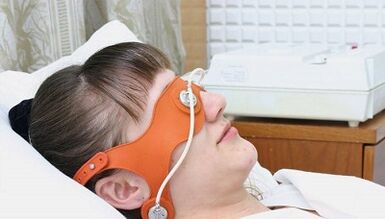
Electrosleep:
- An excellent procedure with a calming effect.
- Thanks to the complete restoration of the body, the papules decrease in size and the disease goes into remission.
- A patient with psoriasis must undergo between 8 and 10 procedures that last between 20 and 60 minutes.
- In the first sessions, patients fall into shallow sleep and then move into deep sleep.
X-ray therapy:
- The affected areas of the skin are treated with X-rays, which accelerate the process of resorption of psoriasis plaques.
- The treatment method involves the use of soft x-rays.
- A session is performed every 4-7 days, the total radiation dose is safe (3.5-4 Gy).
Ultrasound treatment:
- The skin is treated with ultrasound with vibrations at a frequency of 800-3000 kHz.
- The procedure eliminates inflammation, itching and pain, reduces sensitivity to allergens and kills bacteria.
- The cycle of procedures covers from 8 to 14 sessions, each of which lasts a quarter of an hour.
Other effective physiotherapy methods against psoriasis include cryotherapy, immersion in a magnetic field, current treatment and laser.Treatment of psoriasis at home can be accompanied by baths with sea salt (5 g of salt per 1 liter of water, temperature - 37-38 ° C, duration 15 minutes, 15-20 sessions daily).With the appearance of the disease, it is important to go to sanatoriums and participate in health programs.
ultraviolet irradiation
Psoriasis is effectively treated by treating the affected areas of the skin with ultraviolet light.The wavelength should be 311 to 313 nm, but a specialist may recommend a different radiation spectrum.The patient is immersed in a special chamber equipped with ultraviolet lamps.Before this, take photosensitizing medications that increase the effectiveness of the treatment.An effective method of UV therapy is PUVA therapy.The wavelength is 320 to 400 nm.To achieve a good treatment result, the patient undergoes 25 irradiations, resulting in 80% of the affected areas disappearing.
Effective home remedies for treatment at home.
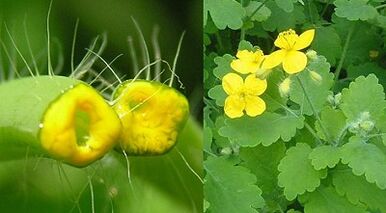
At the initial stage of psoriasis, you can use folk recipes:
- Treatment with chicken egg oil.To obtain half a glass of the product, you will need 20 domestic eggs.Cook the product for 15 minutes after boiling.You will need yolks.Grind them into a paste and fry them in a pan without oil over low heat for 45 minutes.Transfer the prepared dough to cheesecloth and squeeze.Apply the oil to the affected areas 1-2 times a day until psoriasis symptoms are completely eliminated.
- Treatment of the initial stage with complex ointment for psoriasis.Ingredients: 50 grams of birch tar, 20 grams of fat or petroleum jelly, 10 grams of boric acid, 30 grams of honey, 1 chicken egg white, 10 grams of fish oil.Store the product in a dark corner.Lubricate papules 1-2 times a day.
- Treatment with celandine juice.Treat affected skin areas with fresh juice from the roots.At the initial stage, this should be done daily throughout the summer for three seasons in a row.
Features of treatment in children.
Do not use home remedies on a growing organism.They are not always effective and, in this case, delays are completely unacceptable.If the initial stage of psoriasis occurs, parents should take the child to a dermatologist, who will prescribe a full examination and treatment.If the disease has not spread much, children are prescribed topical skin ointments and creams: keratolytics and anti-inflammatory.
With the help of tar, sulfur or salicylic ointment, the upper layer of psoriasis plaques is removed.To do this, a bandage is applied to the skin soaked in the active agent, which is removed after 3-5 hours.Then the child must bathe with a thread;This will help remove the scabs painlessly.The last stage of treatment is the application of glucocorticoid preparations to the skin in the dosage prescribed by the doctor.Children are prescribed antihistamines and vitamin complexes.
What does the initial stage of psoriasis look like?- photo
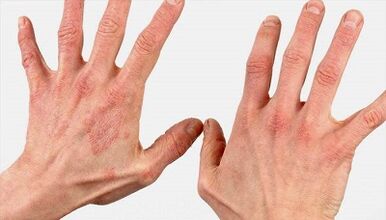
The first stage of psoriasis is accompanied by damage to certain areas of the skin on the body.
If you notice a rash like the one in the photo, go quickly to see a dermatologist.Do not wait in vain for the problem to resolve itself.
This skin disease is complex and requires quick and comprehensive treatment.The sooner a person goes to a specialist, the more favorable the result will be.
Successful therapy leads to rapid remission and restoration of quality of life.